

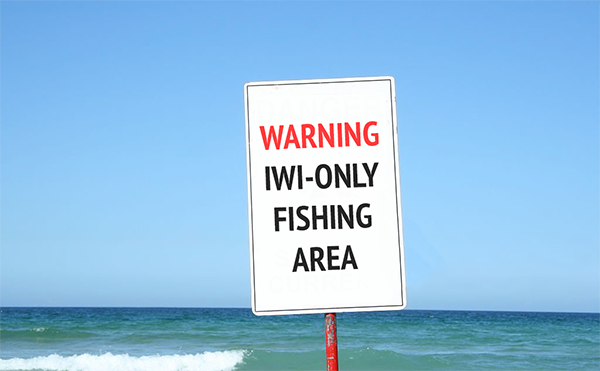
The Hauraki Gulf/Tīkapa Moana Marine Protection Bill has passed its third reading. This legislation provides for new conservation areas—but exemptions for Māori customary fishing and commercial ring-netting weaken the promised protection.
The purpose of the legislation is to address the Gulf's environmental decline by establishing new marine protection areas to protect and restore marine life and habitats. It aims to do so by creating 12 High Protection Areas (HPAs), 5 Seafloor Protection Areas, and extending 2 Marine Reserves.
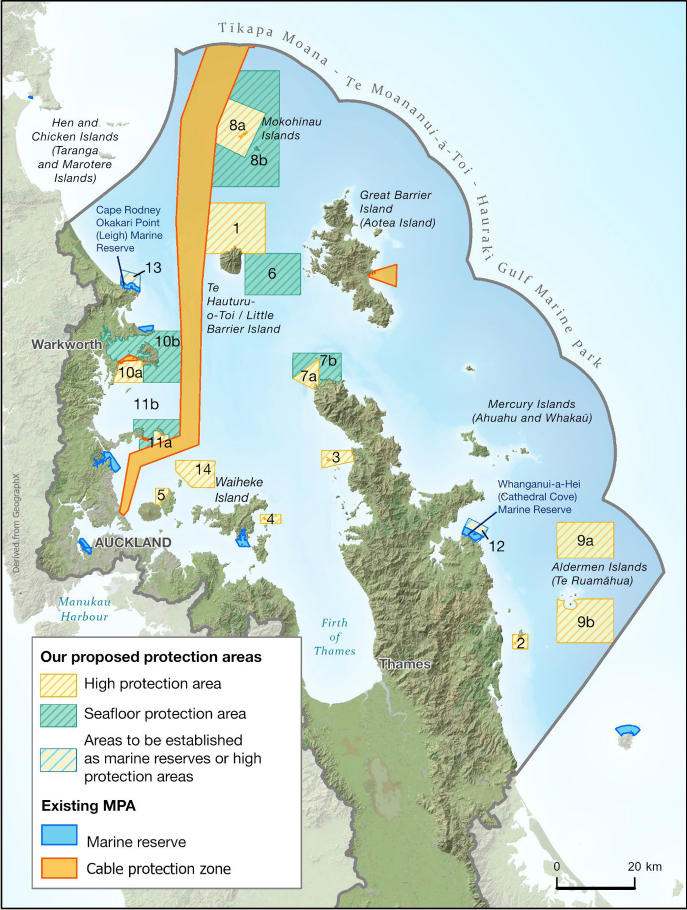
High Protection Areas (HPAs) are promoted as offering strong safeguards, but their protections are weak and uncertain. While all other fishing is banned, two types remain permitted: Māori customary fishing — which is not required to meet biodiversity objectives — and commercial ring-net fishing in two designated “high protection” zones.
Commercial Fishing in High Protection Areas
A July 2025 amendment to the Bill allows commercial ring-net fishing (a form of gill netting) in two HPAs - Kawau Bay and the area around Rangitoto and Motutapu islands. Ring-netting is a method that targets baitfish, a crucial food source for larger predators, such as snapper. Critics argue this harms the food chain and is indiscriminate.
Customary Fishing – without biodiversity safeguards
The July amendment to the Bill also removed the requirement for customary fishing to meet biodiversity objectives within the HPAs.
Minister TAMA POTAKA, when debating the Bill in parliament on 07 Oct 2025, said:
"Some changes have been made; some of them practical, some of them pragmatic. For example, removing the ability for the bill to regulate customary non-commercial fishing, something that other parties were willing to preserve. But I, as a Māori, am not willing to enable the department or others to dictate to iwi and Māori what customary rights happen to be."
This statement confirms that the Government has chosen to exempt customary fishing from environmental obligations imposed on everyone else—an approach that undermines biodiversity protection and erodes the principle of equality before the law.
The goal is to protect 30% of the Gulf by 2030. Yet if this approach continues, it could mean a significantly larger portion of the Gulf being effectively reserved for iwi customary fishing. And if iwi fishers continue to operate outside of regulations and biodiversity objectives meant to safeguard the marine environment, how can these areas be honestly described as ‘protected’ at all?
“Rules for thee, but not for me” - the (non)-policing of customary fishing
The Ministry for Primary Industries (MPI) goes to great lengths to regulate and monitor both commercial fishing quotas (around 400,000 tonnes annually) and recreational fishing (about 7,000 tonnes annually). Yet, customary fishing remains largely exempt from equivalent scrutiny. Under the Fisheries (Kaimoana Customary Fishing) Regulations 1998, 'Tangata Kaitiaki/Tiaki' (iwi-appointed ‘guardians’) are legally required to record and report details of every fishing trip they authorise — information that should, in principle, be subject to the same transparency and accountability standards as other sectors. But, this is not so. In response to a recent Official Information Act request seeking data on Māori customary fishing, MPI refused to release any information. The Ministry claims the data had been supplied “on a confidential basis by guardians” and that its release “was not in the public interest.” This refusal raises serious questions about transparency, accountability, and the consistency of fisheries management across all sectors.
Where are 'the same rights and obligations'?
Fully protected Marine Reserves offer the highest and most effective level of marine conservation. By contrast, creating so-called 'high protection' areas that allow certain groups to fish undermines the very purpose of these protected areas. Such exemptions not only weaken the Gulf’s protection but also flagrantly contradict the coalition partners' stated commitment to equality.
The National–NZ First agreement explicitly pledged to:
“……. defend the principle that New Zealanders are equal before the law, with the same rights and obligations, and with the guarantee of the privileges and responsibilities of equal citizenship in New Zealand.” And: “The Coalition Government will work to improve outcomes for all New Zealanders and will not advance policies that seek to ascribe different rights and responsibilities to New Zealanders on the basis of their race or ancestry.”
Furthermore, the Act Party enthusiastically promotes a commitment to equal rights for all New Zealanders and claims it is working to eliminate divisive, race-based policies. (Act Party website https://www.act.org.nz/defending-equal-rights-democracy).
And yet, these parties have voted for what are effectively iwi-only fishing areas!
Tell the Government to stand up for real marine protection, not watered-down compromises.
Let your local MP, Prime Minister Chris Luxon, Deputy PM David Seymour, and NZ First leader Winston Peters know what you think about the provisions allowing Māori customary fishing and commercial fishing in the Hauraki Gulf’s High Protection Areas. Ask them why they are breaking their promise of the same rights and obligations for all New Zealanders, and why they are failing to uphold the principle of equality before the law. Also, why are they not adopting best practice, science-based protection for one of New Zealand’s most treasured marine environments?
Email:
All MPs' email addresses are available here: https://www.nzcpr.com/parliament/ (Thanks to NZCPR)
References
Hauraki Gulf / Tīkapa Moana Marine Protection Bill
Hansard debate Hauraki Gulf Marine Protection Bill 7 October 2025
Also see previous Democracy Action newsletter articles
- Marine protection secondary to ‘customary rights’ (November 2022)
- New marine protection reserves not created equal for all (October 2023)
- Iwi-only fishing areas given thumbs up by select committee (July 2024)