
< March 2026 newsletter


Taupō Council’s Draft JMA - a major shift in how Taupō is governed

The Taupō Council’s Draft Joint Management Agreement would hand the Tūwharetoa Māori Trust Board unprecedented influence over local decisions. From planning and enforcement to resource consents, powers normally held by elected councillors would be subject to shared decision-making.

Taupō District Council is considering a new Joint Management Agreement (JMA) with the Tūwharetoa Māori Trust Board (the Trust Board). While framed as environmental co-management, the 2025 draft significantly changes how decisions are made, who makes them, and when. These changes raise significant questions about democratic accountability and the principle of one person, one vote.

From Consultation to Governance
The 2009 JMA focused on consultation: the iwi could provide input and participate in hearings relating to Māori multiple-owned freehold land. 

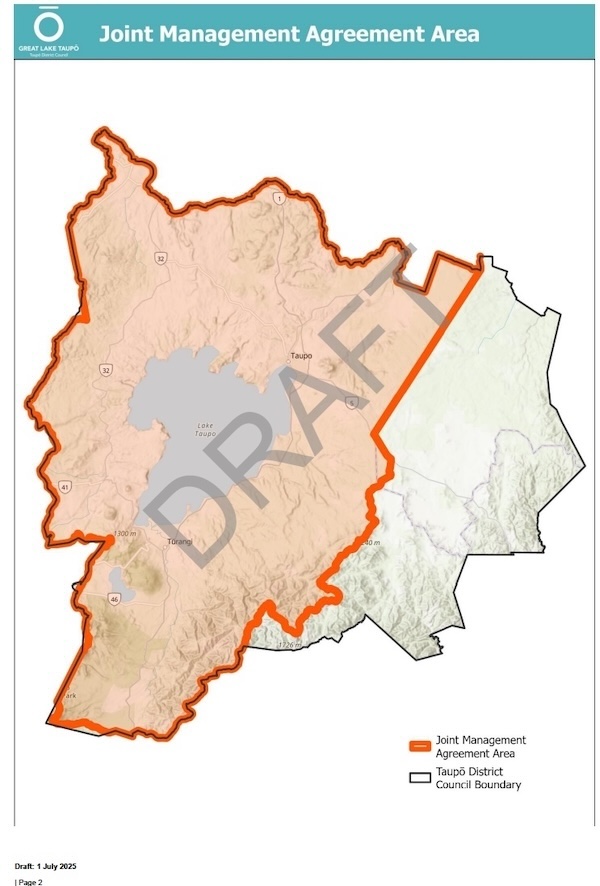
The 2025 draft, however, gives the Trust Board influence early in the decision-making process - before policies are drafted, enforcement priorities set, and resource consent applications submitted - and applies to Lake Taupō, the Upper Waikato River, and all related catchments.

Map of Proposed Area
Key Clauses That Shift Power:

  1. Joint Working Party for District Plan Changes (Clauses 65–68)
    • The Council and Trust Board would form a joint staff working party for any district plan changes.
    • The group jointly decides the scope, content, and recommendations for the plan.
    • Outcome: Key policy decisions would be shaped prior to public consultation, giving the Trust Board significant influence over planning outcomes. 
  2. Monitoring and Enforcement Coordination (Clauses 49–54)
    • Requires bi-annual meetings to coordinate monitoring priorities, enforcement actions, and prosecution thresholds.
    • Allows the Trust Board to participate directly in enforcement decisions.
    • Outcome: The Trust Board gains influence over what environmental issues are enforced and which breaches trigger action, powers normally held by elected officials.
  3. Resource Consent Pre-Application Process (Clauses 82–96)
    • Promotes an engagement framework with the Trust Board (or marae and/or hapū) before applications are lodged.
    • The Council may defer or return applications if early engagement with the Trust Board has not occurred.
    • Outcome: The Trust Board participates in the decision-making process, including in relation to appropriate conditions to be imposed should consent be granted. 

Strategically Important Clause – Potential Transfer of Powers (Clauses 126–127)

  • The draft references Section 33 of the Resource Management Act, which allows councils to transfer regulatory functions to iwi authorities.
  • While powers are not automatically transferred, the clause creates a clear pathway for future authority shifts.

Why Concerns about the Proposed JMA Matter:

  • The draft moves from consultation to shared power in policy development.
  • It introduces a permanent governance committee with equal Trust Board and councillor representation.
  • Operational control would extend to: planning, enforcement, resource consents, infrastructure projects, and even potential future regulatory powers.

Scope and Reach:

  • Covers Lake Taupō, the Upper Waikato River, and all related catchments, far beyond the land-specific focus of the 2009 JMA (which applies to Maori multiple-owned freehold land). 
  • Establishes 3-year joint work plans, strategic planning, and cultural frameworks rooted in a Māori worldview and cosmology.

In Summary:
The draft JMA transforms the Council-Trust Board relationship from occasional consultation into broad, ongoing co-management. Decisions under the council's authority would now be subject to joint agreement, thus reducing public accountability and undermining equality of citizenship. 

What Taupō Council must do under the law — and what the draft JMA plans to do

It is important to know the difference between what is required by law and what the council is proposing on top of that.

What the law requires in a JMA

  • Roles and responsibilities: How the council and iwi will work together on resource management.
  • Consultation: How iwi will be involved in plans and consent decisions.
  • Recognition of iwi interests: Including cultural values, particularly relating to the Waikato River.

However, the JMA proposals go well beyond legal requirements, such as:

  • Enhanced authority: The Board would have direct influence over decision-making, not just a consultative role.
  • Greater influence in public decisions: Powers or influence would be granted to the Board that other citizens do not have.
  • Expanded powers: The proposed joint committee would have power extending well beyond consultation and planning responsibilities.

The law is clear: JMAs are supposed to enable collaboration, not shared authority.

There is no statutory obligation forcing the Taupō District Council to sign this agreement. The law only mandates good faith negotiation, not a guaranteed outcome. And notably, once adopted, the draft makes it clear that future councils cannot easily withdraw, stating that “There is no right to terminate this agreement.” (Cl.164)

If we want local decision-making to stay accountable to the whole community, it is vital to voice our concerns

Residents and other concerned New Zealanders are encouraged to contact the mayor and councillors of Taupō to oppose the proposed JMA and to ensure the importance of equal representation and transparent governance is clearly heard.

Mayor John Funnell - Email: [email protected]

The contact details for the other councillors are available here: https://www.taupodc.govt.nz/council/mayor-and-councillors

N.B. Taupo Council’s third briefing on the proposal will be held from 12:30 – 1:30 pm on Thursday, 19 March at the Council Chambers, 67 Horomatangi St, Taupo. The public is welcome to attend, and it will be live-streamed on the Council's YouTube Channel. For details, see their Facebook post HERE

References

JOINT MANAGEMENT AGREEMENT REGARDING TAUPŌ MOANA AND THE UPPER WAIKATO RIVER

Joint Management Agreement with Tūwharetoa Māori Trust Board – Workshop 3 July 2025

YouTube: Taupō District Council JMA workshop 24 February 2026


Go back to the March 2026 newsletter


RELATED ARTICLES


Co-governance sought over the Waitakere Ranges

Currently, a process is underway in Auckland Council that would give two iwi - Te Kawerau ā Maki and at a later stage, Ngati Whātua - co-governance over the Waitakere Ranges Regional Park and the Waitakere Ranges Heritage Area. Another proposal currently under consideration, also initiated by Te Kawerau ā Maki, involves restricting public access to a considerable section of the regional park. This area accounts for 35% of the park's total land. Implementing this proposal would eliminate 19 tracks, with 3 being partially closed and 16 fully closed. Continue reading

Whanganui council agrees to partner with Whanganui Māori

Whanganui iwi have successfully convinced the Whanganui District Council to adopt a proposal to create of a platform for joint initiatives that detail how the council is to partner with the post-settlement governance entity proposed by the Whanganui Land Settlement Negotiations Trust (WLSNT). Continue reading

The Great Tree Massacre

Photo: Once was a magnificent Moreton Bay Fig In July/August 2023 the Tūpuna Maunga Authority destroyed around 60 healthy mature trees on Ōtāhuhu Mt Richmond. Their crime - they were not native. And it has said it is coming back for more. Continue reading

Where the parties stand on co-governance

Many of us are opposed to co-governance and believe that decision-making must be fair, transparent, and democratic, with all decision-makers accountable to the citizens. This being so, we have reviewed the main political parties to find out their stance on co-governance - both in general and specific to the Hauraki Gulf. The parties appear in alphabetical order. Continue reading

Warning from Northern Ireland – co-government does not work

The Northern Ireland governing system established 25 years ago is set up as a power-sharing style of government that relies on the cooperation of different social groups. This arrangement has not delivered the normalised, shared, and de-polarised democracy which was promised by political leaders and pro-consociation theoreticians. It has serious flaws, many of which have become apparent over time. Continue reading

What the hell is co-governance? An explainer……

‘Co-governance’ is an emerging and developing model of decision-making in New Zealand. The term refers to a shared governance arrangement - with representatives of iwi on one side, and representatives of central and/or local government on the other, each side having equal voting rights at the decision-making table. Continue reading

The thugs’ veto visits Orewa

Last month, Julian Batchelor of Stop Co-Governance held a public meeting at the Orewa Community Centre to raise awareness of the dangers of co-governance, and to gather political support to stop it. However, a rabble of badly behaved people sparked a noisy counter protest. This was obviously an attempt to sabotage the event to prevent Mr Batchelor from airing his views. Continue reading

Human Rights Commission partners with Iwi Chairs’ Forum

The Human Rights Commission (HRC) is supposedly an independent Crown entity, but this is no longer the case. It appears to be greatly influenced by the National Iwi Chairs’ Forum, a group seeking a profound change to the existing political order. Continue reading

Say no to co-governance petition

Here's our chance to force a referendum on co-governance. Please get in behind a recently-launched petition with the question: “Should New Zealand implement a form of co-governance where 50% of elected representatives to Parliament and local authorities (including community boards and local boards) be elected by voters of Maori descent, and 50% by non-Maori?” Continue reading

Co-governance does far more than ‘tweak’ democracy

Co-governance is a manifestation of the Treaty ‘partnership’ ideology. To date co-governance has largely been confined to Treaty settlements over specific natural resources. However, this is now expanding to cover public services and local authorities. Continue reading

Co-governance advocates bully dissenter on Hauraki Gulf Forum

  Below is an email sent to members of the Gulf Users Group on 28 April 2022: I am writing to bring your attention to an attempt by the Hauraki Gulf Forum’s co-chairs to muzzle Auckland Councillor John Watson, a Forum member, after he shared on social media our NZ Herald advertisement. This advert named the five local body councillors who voted to introduce a new 50:50 co-governance arrangement with mana whenua and ‘others’ to manage the Hauraki Gulf Marine Park. Furthermore, these five Councillors failed to seek a mandate from the public and ignored the concerns of thousands that had signed our petition or emailed Forum members. Continue reading

Rotorua Lakes Council pushing for Māori co-governance

The Rotorua Lakes Council no longer believes in one person one vote, each of equal value. Instead, it believes that if you are not Māori, your vote should be worth less. The Council is currently pursuing a law change to enable an undemocratic representation model to be implemented. The model it prefers would consist of three Māori ward seats, three general ward seats, and four at-large seats. However, adopting this arrangement would give the 19,791 citizens on the Māori roll 2.6 times the voting power of the 51,618 citizens on the general roll. Continue reading

No place for democracy in Ngāi Tahu grab for political power

Oral submissions on the bill to entrench Ngāi Tahu seats on Environment Canterbury were heard by the Māori Affairs Committee last week – and those who watched the proceedings report that there were considerably more presentations in opposition than those in support. Continue reading

PROPOSED CO-GOVERNANCE OF ALL 28 AUCKLAND REGIONAL PARKS

The partnership ideology under the Treaty of Waitangi is poised to extend to the management of Auckland’s 28 Regional Parks if provisions in the Draft Regional Parks’ Management Plan are adopted. Continue reading

Māori seats in local government a step to 50-50 power share

Photo: Andrew Judd hiding from a taniwha Before the ink has dried on the establishment of separate Māori seats on 38 councils, calls for "more equitable representation and a partnership with Māori" in a 50/50 power sharing model have arisen - not only from Māori sovereignty activists, but also from some councillors. Continue reading

Iwi push for 'tripartite governance'

A letter to the New Zealand Productivity Commission from the Auckland Council Mana Whenua Kaitiaki Forum (a collective of the 19 hapū and iwi authorities), dated 22 August 2019, reveals an agenda that turns democracy on its head. The letter talks of an “emerging tripartite governance” – over land and water, comprising central government, local government, and mana whenua. Continue reading

Citizens stand up to the Tūpuna Maunga Authority

The Tūpuna Maunga Authority* (TMA), who control Auckland’s 14 volcanic cones (tūpuna maunga), is once again causing consternation amongst the people of Auckland - this time by wielding its powers in a destructive and seemingly vengeful way. Waging utu on the exotics? The TMA has plans to remove 2,000 exotic trees from the 14 maunga, and is currently in the process of implementing its decision. Continue reading

More co-governance to be served up to unsuspecting communities

Increasingly Treaty of Waitangi settlements are including a requirement to enter into co-governance arrangements. The Ngāti Hinerangi Claims Settlement Bill, which had its first reading in parliament on 19th September, is one such settlement. The Bill announces the intention to introduce a co-governance arrangement over the upper part of the Waihou and Piako river catchments areas. Continue reading

Co-governance – the Trojan horse of iwi control

Some think co-governance is being nice and inclusive - but it's not working out that way in practice. All is not well in the co-governance arrangements we have been observing in Auckland. We have reported previously on how the citizens of Devonport have been treated by the Tūpuna Maunga Authority. This unfortunate state of affairs was reinforced at the Authority’s hui on May 6th. Continue reading

The Maori world view - 'military' style gates on Mt Albert

Users of Ōwairaka, the maunga in Auckland's Mt Albert, are objecting to the ‘military’ style gates designed to enforce the summit vehicle ban. Comments include words such as "hideous", "an atrocity", and “out of step with the place's natural beauty”. Continue reading

Advancing the co governance agenda

Auckland Council recently released a discussion document on developing ‘a water strategy to ensure a secure, sustainable, and healthy future for water in Auckland’ - Our Water Future: Auckland's water discussion. Continue reading

Auckland Council’s ‘Our Water Future’ - Remember to have your say

Auckland Council recently released a discussion document on developing ‘a water strategy to ensure a secure, sustainable, and healthy future for water in Auckland’. We covered this issue in the March update, but to briefly recap, as to the advancement of a co-governance agenda, concerns centre on the following statements: Continue reading

Draft Auckland Plan Subverts Democracy

In last month’s newsletter, we went into some detail about how the Draft Auckland Plan 2050 is promoting the subversion of our democracy by bestowing extra co-governance rights on a group of citizens based on race, and requiring the recognition of ‘mana whenua’ as rangatira (chief) in Tāmaki Makaurau (Auckland). Continue reading