

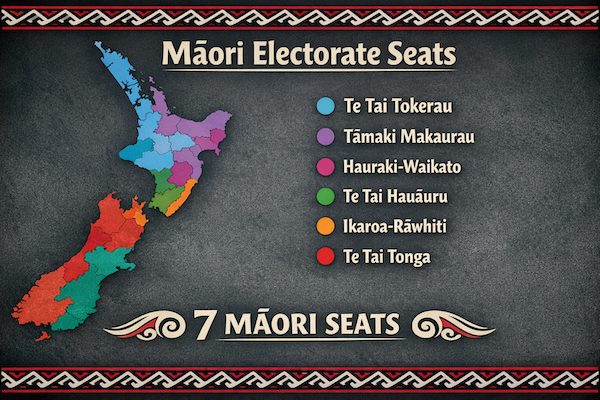
While the Māori seats were historically a tool for inclusion, they now institutionalise separatism, unequal treatment, and electoral distortions. Abolishing them would better align with MMP's core principle of proportional, equal representation for all citizens, promote national unity, eliminate overhang risks, and remove ethnicity-based privileges—allowing New Zealand's democracy to operate on principles of equality, fairness and shared citizenship.
The Māori electoral seats, originally established to provide Māori representation in Parliament, have long been defended on historical grounds. However, in modern New Zealand, retaining these seats under the Mixed-Member Proportional (MMP) system raises serious concerns. Evidence suggests they now institutionalise separatism, perpetuate discrimination, and distort the proportionality of our electoral system.
The Māori seats entrench ethnic separatism
The existence of separate electorates for Māori implies that ethnic identity, rather than citizenship, is the primary basis for political representation. This runs counter to a unified New Zealand, where ethnicity is acknowledged but does not bestow privilege, and all citizens are equal under the law.
- Māori seats symbolise political separation and encourage a division of the nation along ethnic lines.
- Historical justifications for separate Māori representation are no longer compelling. With universal suffrage and MMP, Māori are fully enfranchised and can achieve representation through general electorates or party lists.
Discrimination and Inequality
The Maori seats breach the principle of democratic equality:
- The Māori Electoral Population calculation, which includes a proportion of people of Māori descent who are not registered as electors and a proportion of those who are under the age of 18, inflates representation artificially.
- Māori electorates have fewer voters per MP than general electorates. In the 2023 election, there were 3,241042 people on the general roll represented by 65 general electorate MPs — about 49,862 voters per MP. On the other hand, there were 262,365 people on the Māori roll represented by 7 Māori electorate MPs — about 37,480 voters per MP, which is far more than the 5% electorate population tolerance.
- This discrimination undermines fairness and equality, granting Māori roll voters disproportionate influence relative to the general population.
Distortion of MMP Electoral Outcomes
Under MMP, overhang seats occur when a party wins more electorate seats than its share of the party vote. The Māori seats contribute to overhang risks, giving disproportionate leverage to Māori-focused parties:
- Overhang can distort proportional representation, undermining the expressed will of the electorate.
- Te Pāti Māori has benefited disproportionately, using overhang seats as leverage in coalition negotiations.
- Abolishing the Māori seats would reduce overhang risk, restoring the proportionality principle at the heart of MMP.
Historical Paternalism and Political Isolation
The Māori seats were historically designed to protect Māori interests in a predominantly European Parliament. However:
- Modern political structures, including general electorates and party lists, allow Māori issues to be raised without special electorates.
- Māori seats can remove Māori issues from mainstream political debate, isolating them within a separate bloc.
- By perpetuating ethnicity-based representation, the seats reinforce identity politics, rather than fostering a shared national agenda.
Social Division and National Cohesion
Empirical and historical assessments indicate that the Māori seats have contributed to ethnic division:
- The 1986 Royal Commission on the Electoral System warned that race-based representation creates an undesirable degree of societal division.
- Retention of separate seats is embedding permanent ethnic distinctions in political life, weakening national cohesion.
Conclusion
The Māori seats, once justified as a measure of inclusion, now institutionalise separatism, discrimination, and electoral distortion. Modern electoral mechanisms provide adequate representation without separate electorates, while abolition would:
- Promote national unity and cohesion.
- Ensure equitable, merit-based representation under MMP.
- Reduce the risk of overhang distortions, restoring proportionality.
- Remove the legal sanction for ethnically based political privilege.
For these reasons, it is recommended that the Māori electoral seats be abolished, allowing New Zealand’s democratic system to operate on principles of equality, fairness, and national unity.
References
Data-sources-and-imputation-for-maori-descent-in-the-2023-census-updated.pdf
Media coverage
NZ First Bill to Enable Binding Referendum on Māori Seats at 2026 Election
Hobson’s Pledge: Referendum On Māori Seats Must Be Put To Voters This Year
Commentaries
- Gary Judd KC: Maori seats foster self-ghettoisation
- Muriel Newman: The Future of the Maori Seats
- Chris Lynch: Seymour defends Treaty stance, backs removal of Māori seats
Further reading
THE TRUTH ABOUT THE MAORI SEATS - A dissertation by Jeremy Sparrow