

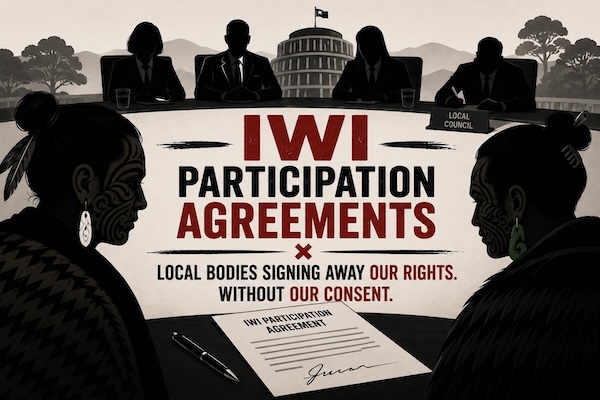
A major shift in local government is occurring through Mana Whakahono ā Rohe (MWaR) agreements under the Resource Management Act.
- These agreements are creating long-term participation and governance arrangements between councils and iwi authorities.
- The growing use of MWaR agreements is raising wider questions about democratic accountability, public oversight, governance, and who ultimately makes decisions affecting local communities.
- The Far North District Council’s agreement with Te Rūnanga-Ā-Iwi-Ō-Ngāpuhi demonstrates how extensive these arrangements can become.
|
While public attention is largely focused on the argument over the Treaty principles and unelected people with voting rights on council committees, a transformation of local government has quietly been advancing through New Zealand’s current resource management system.
Under the Resource Legislation Amendment Act 2017, Councils can be required to enter into a “Mana Whakahono a Rohe” (MWaR) process to negotiate participation arrangements with iwi authorities and, potentially, hapū groups.
What are Mana Whakahono ā Rohe Agreements?
Mana Whakahono ā Rohe are formal relationship agreements created under sections 58L–58U of the RMA. They set out how iwi authorities and councils will work together on resource management matters.
These agreements go beyond normal consultation requirements by establishing ongoing arrangements that enable iwi to participate in decision-making processes. In practice, Mana Whakahono ā Rohe agreements may provide for:
- Participation in planning and policy development
- Involvement in resource consent processes
- Monitoring and compliance-related activities
- Information-sharing arrangements
- Consultation and engagement procedures
- Participation mechanisms relating to resource management decisions under the RMA
The legislation provides considerable flexibility regarding the content of agreements and contains broad provisions regarding matters that may be included.
The implications are now becoming visible around the country.
The Bay of Plenty Regional Council (BOPR) was the first local authority in the country to receive an iwi authority Mana Whakahono a Rohe invitation. In an article published in the June 2018 issue of the NZ Local Government magazine, the Maori policy team leader of the BOPR Council, Anaru Vercoe, wrote:
“….. for council this has represented a paradigm shift where decision-making is on equal footing, and that the usual discretionary powers it exercises have been tempered by the provisions of the MWR”.
That is an extraordinary admission. Whether this interpretation reflects how the legislation operates remains to be seen.

The Far North Agreement: A Case Study
However, if the Far North District Council’s Mana Whakahono ā Rohe (MWaR) agreement with Te Rūnanga-Ā-Iwi-Ō-Ngāpuhi is any indication, Vercoe's statement may not be far from the truth. This agreement goes well beyond a standard consultation arrangement and establishes a long-term partnership framework between the Council and Ngāpuhi across planning, governance, hearings, funding, and resource management processes. While Parliament originally intended MWaR provisions to improve Māori participation in resource management, the FNDC agreement includes broader provisions such as funded participation, governance involvement, influence over district planning and resource consent processes, representation on committees and forums, pathways toward future joint management or transfer of powers, and recognition of “Māori as the sovereign people of Aotearoa/New Zealand” — wording not required by the Resource Management Act but adopted as a political choice by the Council.
The agreement embeds Ngāpuhi participation across a wide range of Council activities and is likely to have a significant influence on how the Far North District Council operates in the years ahead.
And there is much more to come! The Far North District Council is currently progressing major MWaR agreements involving five further iwi and one hapū. Council communications reportedly indicate an urgency to complete these agreements before proposed RMA reforms, which may change or replace the current framework.
Similar developments are occurring elsewhere around the country, suggesting councils and iwi are moving in haste to finalise agreements before the Government’s replacement resource management legislation takes effect. There are also reports that templates based on the FNDC–Ngāpuhi agreement are being circulated to iwi nationwide.
For a list of completed MWar agreements and those currently under negotiation, click HERE
Questions of cost, control, and accountability
- Long-term obligations bind future councils
One of the most troubling aspects of MWaR agreements is their enduring nature. Current councils can commit future councils to long-term arrangements that cannot be altered without the agreement of the parties.
- Substantial complexity and cost.
There is no limit on how many agreements councils may be required to enter into. The legislation clearly allows for multiple iwi authorities and multiple agreements. Auckland Council, for example, recognises 19 iwi authorities. If each sought a participation agreement, the council could potentially face 19 separate arrangements.
The legislation also allows for hapū participation arrangements — notably, there are thousands of hapū groups throughout New Zealand.
Tribal boundaries often overlap multiple council jurisdictions. Ngāti Paoa, for example, claims interests across the areas of seven different local authorities.
Councils may therefore find themselves attempting to reconcile:
- multiple agreements,
- overlapping claims,
- competing iwi perspectives,
- and the wider interests of the public.
Who pays?
The legislation does not specify who funds the establishment and ongoing operation of these agreements. In practice, those costs are largely falling on councils and therefore ratepayers.
Questions communities are now asking
As MWaR agreements continue to expand around New Zealand, communities are increasingly beginning to ask legitimate questions:
- Should agreements with major governance implications proceed without broad public consultation?
- What powers and influence do these arrangements create in practice?
- How much influence do they have over planning decisions, public assets, reserves, and resource consents?
- What financial obligations will they impose on councils and ratepayers?
- What level of transparency and public oversight exists once agreements are signed?
- How councils manage and coordinate multiple agreements simultaneously?
- Why are councils rushing to finalise agreements before major RMA reforms potentially change the system altogether?
These are not fringe concerns. They go to the heart of democratic accountability, equal citizenship, and who ultimately governs local communities.
What we can do
Mana Whakahono ā Rohe agreements are being negotiated now — often with little public awareness and before major RMA reforms take effect. Once signed, these arrangements can shape council decision-making for years to come.
If you are concerned about transparency, accountability, and democratic oversight in local government, now is the time to act.
We urge you to:
- Write to your local MP and to the Minister responsible for RMA reform, Chris Bishop, urging the Government to place an immediate moratorium on any new Mana Whakahono a Rohe (MWaR) agreements. Email: [email protected]
- Contact your mayor and councillors and ask whether your council is negotiating MWaR agreements.
- Request that all draft agreements be publicly released before signing.
- Ask councils to hold full public consultation and public meetings on any proposed agreements.
- Seek clarity on the long-term financial costs and governance implications for ratepayers.
- Share information with your community so these agreements are openly debated before they are finalised.
References
Resource Legislation Amendment Act 2017
Ministry for the Environment:
- Mana Whakahono ā Rohe: Iwi participation arrangements
- Changes to Māori participation in the Resource Management Act 1991
Mana Whakahono ā Rohe between Ngāti Tūrangitukua & Taupō District Council
Media coverage
https://www.rnz.co.nz/news/ldr/593961/two-more-iwi-seek-agreement-with-taranaki-council
https://www.1news.co.nz/2026/04/25/under-threat-council-looks-to-advance-iwi-deals/